


Globalization has not just created immense value for China; it has also transformed the country into a superpower of world commerce and an unrivaled export machine with the ability to exert significant influence over supply chains.
In a recently-published report, Dealing with Supply Chain Dependencies: Challenges and Choices, the EU Chamber of Commerce in China argues that China is using such dominance to exert pressure on its trade partners, for example, through export controls, and putting an additional strain on an already tense global trading environment.
However, such an approach is now being met by increasing pushback from other countries and regions, including the European Union (EU).
The bloc continues to take in ever greater quantities of goods from China. The result is, for the first time, that China has a larger trade surplus with Europe than with the US, a development that poses serious questions over the future of European industry.
In an interview with French business newspaper Les Echos at the beginning of December, which followed his state visit to China, French President Emmanuel Macron claimed that China was “striking at the heart of the European industrial and innovation model.”
He warned that if China did not take measures to reduce its trade surplus with the EU, Brussels would be forced, in the coming months, to take decisive action and follow the example of the US, such as imposing tariffs on Chinese products.
Whether Macron will be able to garner sufficient support to push through such a move among the EU's 27 member states is open to question, given that the prevailing default position in Brussels on China appears to be 'do not rock the boat'.
Reducing reliance on the World’s second-biggest economy
Certainly, Jens Eskelund, the EU Chamber of Commerce in China's president, who also heads the Chinese subsidiary of Danish ocean shipping giant Maersk, believes momentum is gathering for the EU to take a more offensive stance about China and implement its own trade measures to reduce businesses’ reliance on the world’s second biggest economy.
“(Supply Chain) dependencies are being discussed in much more detail than they were before ... Are we even sure Europe can manufacture toothpaste without ingredients sourced in China?” he told a media briefing ahead of the publication of the Chamber’s report. “The higher that (Chinese) production goes up, the higher the risk that countries will begin to react,”
He points to China facing a record high of almost 200 WTO trade investigations last year, well over half of which were from developing countries.
The degree to which businesses in Europe and elsewhere in the world were reliant on China for goods was brought home forcefully during the Covid-19 pandemic, when the lockdowns to control the spread of the virus disrupted production and wreaked havoc on supply chains.
However, Eskelund claims that the stakes are far higher now for businesses compared to the pandemic, as politics has entered the equation.
“Your primary concern was whether you had a supply chain that could physically deliver the product, but this has shifted to one where the question is whether your supply chain is dependent on a certain government position. That’s actually a big shift,” he said.
The report recommends that the Chamber's members “eliminate single-source dependencies” on the U.S. and China and calls on EU decision-makers to “accelerate plans to identify and eliminate critical dependencies.”
Continuity in new Chinese ‘Five-year Plan’
Eskelund underlines that Chinese exports have continued to gain traction in the European Single Market, partly due to technological and quality advancements in some industry sectors, but have also been substantially supported by macro-economic developments.
“For example, in 2025, the renminbi sank to a 10-year low against the euro despite China boasting exceptionally high trade surpluses with Europe that are now set to exceed €400 billion for the year.
“Moreover, China has now experienced 37 consecutive months of factory gate deflation as the output in many industries consistently exceeds what domestic and global markets can absorb. There is currently no end in sight to this situation.”
Initial feedback on China’s forthcoming ‘Five-year Plan' points to policy continuity with the previous one, with a continued focus on self-reliance and establishing ‘complete industrial systems’ at ever higher levels of technical sophistication.
“It implies, all things being equal, that the present-day deflationary environment and the disparity between supply and demand - often stemming from key industries subject to industrial policy support, including industries important to Europe - is unlikely to fundamentally change,” Eskelund commented.
Rare Earth export controls: a Turning point?
The EU has been criticized for being slow to react to the numerous concerns raised by the US about how China has been able to use its manufacturing prowess to dominate global trade.
However, the move this year by China to impose export controls on rare earth elements and its subsequent announcement of extra-territorial controls may represent a turning point, with Brussels now seriously considering how to reduce its dependence on China for critical materials.
That the EU is now placing more emphasis on securing its own industrial future should come as no surprise to China, particularly as the underlying reasons are not materially different from those that have been expressed for many years in China’s Five-Year Plans and policy statements that have a strong focus on self-reliance, Eskelund notes.
“Precisely how the EU will respond is not yet clear, but it could conceivably choose to develop and implement more targeted policies that - like many of China’s - address specific industrial resilience and economic security concerns, albeit much more limited in nature.”
Ever-increasing exports or real collaboration?
Summing up, the Chamber’s report states that China faces a fundamental choice: it can continue with its current trade policy of exporting an ever-increasing volume of goods to Europe, as well as other countries, irrespective of the impact on industrial resilience and employment in these countries; or it can adopt a more measured approach, working with trade partners to address concerns, taking into account the interests of all sides, and prioritizing a sustainable model over short-term gains.
Should China choose the former, the prevailing climate of global uncertainty and the negative impact this has on supply chains is likely to stay for the long term. However, should it decide to put the emphasis on real collaboration with Europe, the two markets could move into a space where differences can be managed without creating unnecessary inefficiencies and losses for both companies and economies, although certain tensions will remain.
Over time, China’s ability to exercise control over key supply chains through measures like tariffs and export controls could decrease as other countries’ self-reliance initiatives mature.
Most European companies present in China today will remain for as long as they can, given the country’s innovation ecosystem and unparalleled manufacturing capacity. But both their willingness and ability to place China at the center of their global supply chains may well diminish, depending on whether and how China decides to continue leveraging its current dominance, the report concludes.
Source: https://www.ajot.com/insights/full/ai-china-trade-dominance-is-the-eu-poised-to-fight-back

Việt Nam’s semiconductor exports grew at a compounded annual rate of 31.8 per cent between 2006 and 2025, while imports grew by 30 per cent a year during the same period.
Airfreight rates appear strong as the peak season draws near, with year-on-year gains on transpacific lanes robust while Asia-Europe rates start to recover following the end...
Data-centre investment is reshaping trade flows and putting new pressure on the industry's capacity balance, with hi-tech now the main engine of air cargo growth, according...
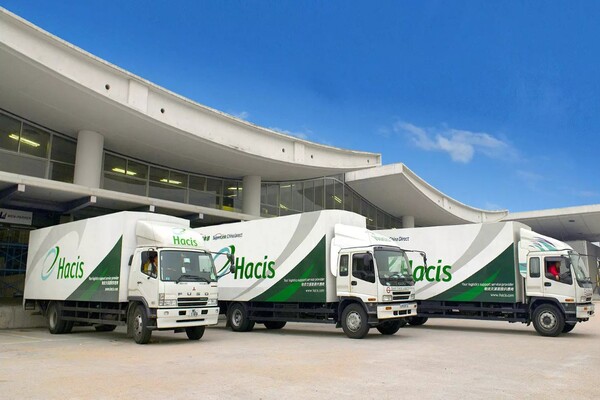
Building on the pilot shipment from Hanoi, Hacis is developing its Vietnam–Hong Kong road feeder service to offer exporters greater routing flexibility and access to Hong...
Container spot freight rates on Asia–Europe routes have rebounded after three consecutive months of decline, ahead of new Freight All Kinds (FAK) rate increases scheduled...
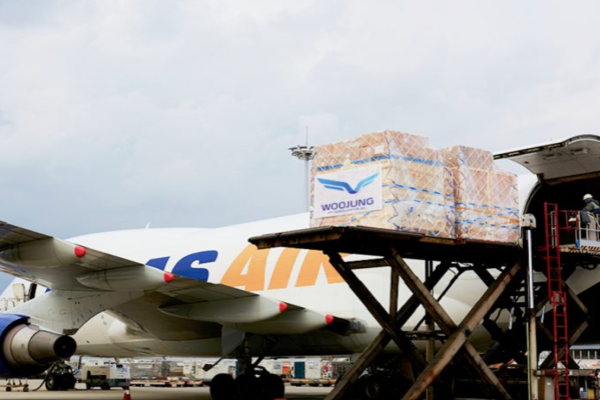
Samsung SDS is expanding its airfreight operations through the acquisition of South Korean cargo consolidator Woojung Air. The deal will strengthen Samsung SDS’s access to...
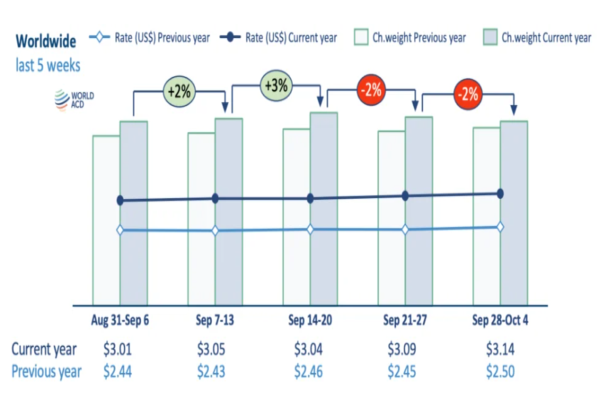
Worldwide air cargo tonnages bounced back strongly in September following their August lull, with volumes rising +3% compared with the previous month and growing +9%, year...
The rapid growth in demand for artificial intelligence (AI-related) goods that has consumed air cargo capacity out of Asia has also helped insulate global trade against tariffs...

Samsung SDS – the IT solutions and logistics arm of Samsung – is expanding its presence in air cargo through the acquisition of Korean airfreight consolidator Woojung Air...
Geopolitical uncertainty and digital transformation are reshaping global logistics, making supply chain resilience a strategic priority. FIATA emphasises the need for diversified...

 ALS
ALS