


As airfreight faces increasing risks from undeclared lithium-ion batteries and evolving regulatory demands, the humble unit load device (ULD) is being redefined. No longer just a container for cargo, ULDs are becoming frontline safety tools—engineered to prevent catastrophe at 35,000 feet. At the heart of this evolution is a new generation of fire containment technology developed by leaders like AmSafe Bridport and its subsidiary Nordisk Aviation.
From fire-resistant materials to full-scale lithium-ion battery fire testing, the development of next-generation ULDs marks a shift in how the industry thinks about risk. “Nordisk’s containers are designed to be more than just cargo carriers,” explains Chris Kumar, General Manager for Nordisk Aviation Products. “They are a crucial part of an aircraft’s onboard safety system.”
Building safety into the core of airfreight operations
The threat posed by lithium-ion batteries is no longer theoretical—it’s a growing reality. Carried knowingly or not, these batteries are one of the most dangerous cargo items in modern aviation. That’s why Nordisk’s new fire-resistant AKE containers aren’t simply an upgrade—they’re a necessity.
“Our advanced fire-resistant AKEs exemplify this shift,” says Kumar. “They’re engineered specifically to contain lithium-ion battery fires while maintaining structural integrity under extreme conditions.”
The development of these solutions is part of a broader industry trend toward treating ULDs not just as logistics equipment, but as integral safety components. “As the industry redefines ULDs as risk-mitigation tools, our focus remains on containment, survivability, and structural resilience—enabling crews to manage in-flight incidents and land the aircraft safely.”
That focus has led Nordisk to push the limits of current testing norms. Working alongside Emirates, the company helped design a test scenario that went far beyond regulatory minimums. “We loaded an AKE container with 1,000 lithium-ion battery cells distributed across 60 pieces of luggage, including clothing, alcohol bottles (95 percent alc.), and toiletries,” he explains. “This is about as close to a real-world fire scenario as you can get.”
Why Certification Isn’t Enough Anymore
AmSafe Bridport was the first to achieve FAA TSO-C203 and EASA ETSO-C203 certification for fire containment covers—setting the bar for the rest of the market. But as Kumar notes, real innovation has outpaced the regulatory framework.
“These certifications have driven the entire market toward higher safety expectations,” he says. “But our certification work has also inspired new materials, configurations, and testing methods that go beyond the current Class A fire standard.”
That evolution matters. The existing standards, like SAE AS8992, were largely designed around paper-based cargo fire scenarios. Lithium-ion fires behave very differently—hotter, faster, and much harder to extinguish.
“We’re now moving into a space where standards are shifting toward performance-based compliance,” says Kumar. “Certification may soon require more rigorous, real-world stress testing—something we’ve already started integrating into our product development cycle.”
That future-forward mindset is already showing up in ULD design. “We’re seeing innovations like intelligent materials, modular fire barriers, and gas venting systems that support containment without compromising performance. And with ESG goals gaining traction, sustainability metrics will also become a requirement, not an option.”
Designing for flexibility, sustainability—and the unknown
Modern airfreight operations aren’t limited to wide-body aircraft. Narrow-body conversions, dedicated freighters, and mixed fleets all require flexible solutions. AmSafe and Nordisk design fire containment ULDs with this diversity in mind.
“Flexibility is at the core of our design philosophy,” says Kumar. “Our containers are lightweight, modular, and compatible with a wide range of aircraft types—from wide-body freighters to emerging narrow-body conversions.”
More than that, sustainability is being designed in from the outset. “These containers are sustainable, with most components being 100% recyclable. They deliver fire protection without compromising load configuration or operational requirements.”
Still, one of the biggest challenges remains balancing safety with fuel efficiency. “Many safety solutions add weight,” he acknowledges, “but Nordisk’s recyclable and lightweight AKE container, along with AmSafe’s latest fire containment covers, offer improved protection at lower weights. Every design iteration balances safety, structural performance, and reduced carbon footprint.”
Solving real problems, one fire test at a time
What sets Nordisk apart is its willingness to solve problems that others haven’t yet confronted. The Emirates fire test isn’t just a technical milestone—it’s a symbol of their approach.
“The container withstood six hours of fire exposure,” says Kumar. “It safely vented smoke while preventing oxygen ingress. That kind of real-world validation defines our client-first approach.”
That feedback loop between operator concerns and product development is constant. “At Nordisk Aviation, we bridge customer feedback directly into our R&D stream,” he adds. “Airline concerns—about weight, dangerous goods, or compliance—are rapidly converted into test cases.”
This agile, test-driven development cycle means Nordisk can respond faster to emerging risks and regulatory changes. “It’s how we stay ahead of both the regulatory curve and real-world operational challenges.”
The awareness gap: Education and opportunity
Despite these innovations, not everyone in the cargo chain understands what today’s ULDs are capable of—or what they’re up against.
“Awareness varies widely,” says Kumar. “While top-tier airlines are clearly prioritising advanced containment, many shippers still lack training in identifying fire risks or understanding the protective capabilities of modern ULDs.”
Undeclared batteries remain a particular concern. “The gap is particularly stark for consumer goods and mixed baggage. Industry bodies must promote unified training, and manufacturers must offer hands-on demos and risk education tools.”
This isn’t just about safety—it’s about brand trust, transparency, and ESG credibility. “Fire containment is no longer just a compliance tool; it’s a brand differentiator,” Kumar argues. “Airlines that deploy advanced ULDs show proactive risk management and position themselves as industry leaders in both safety and sustainability.”
New framework provides legal recognition for negotiable transport documents across all modes, supporting digital trade and operational flexibility.
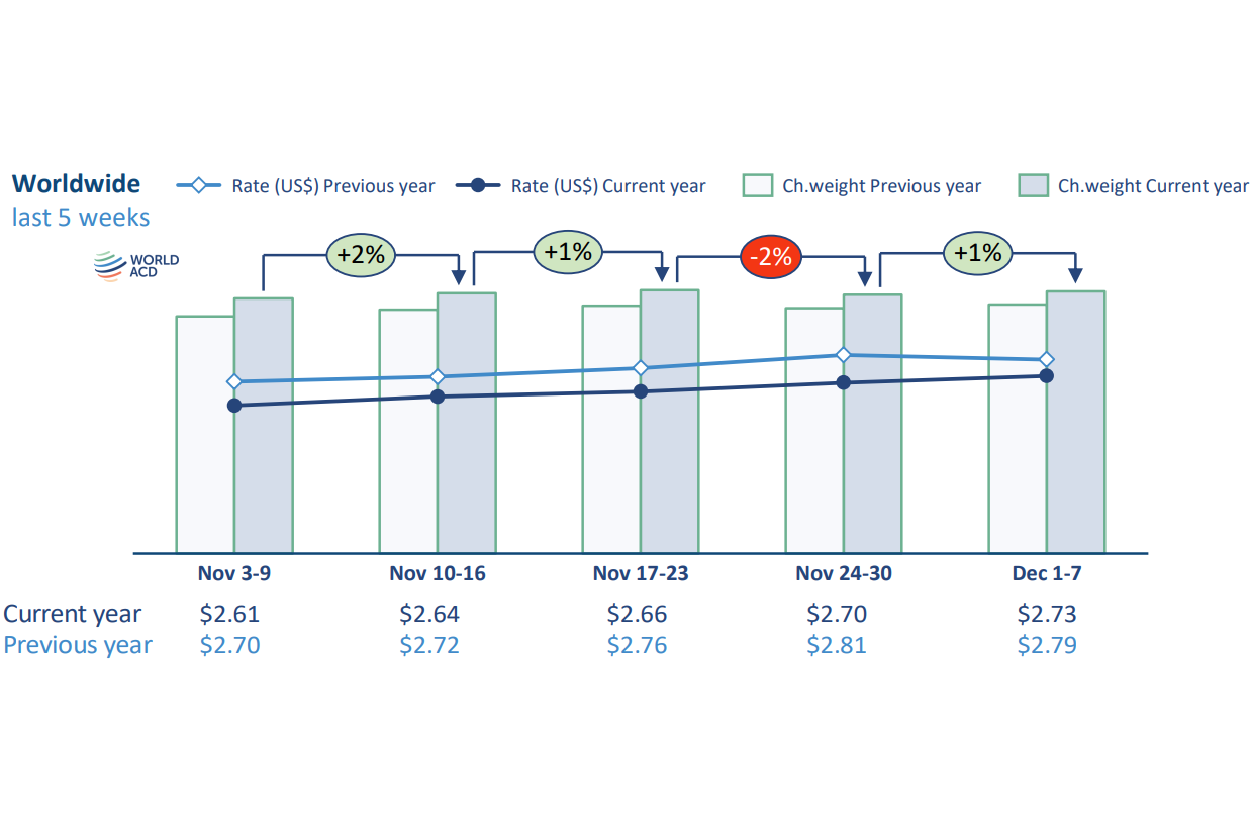
Spot rates rise a further +3% in first week of December

The data was obtained by narrowing down all semiconductor commodity types to the 10 most essential categories.

A reduction in scope of the European Union’s sustainability disclosure rules may cut red tape for businesses but investors say less transparency will make it harder...

Global supply chains face persistent disruption risk in 2026 as logistics operators adopt artificial intelligence and new security models, according to senior executives at...
Airports Council International Asia-Pacific & Middle East (ACI APAC & MID), the trade body representing over 600 airports, released its latest outlook on air cargo performance...

The International Air Transport Association (IATA) released its latest financial outlook for the global airline industry showing a stabilization of profitability even as supply...
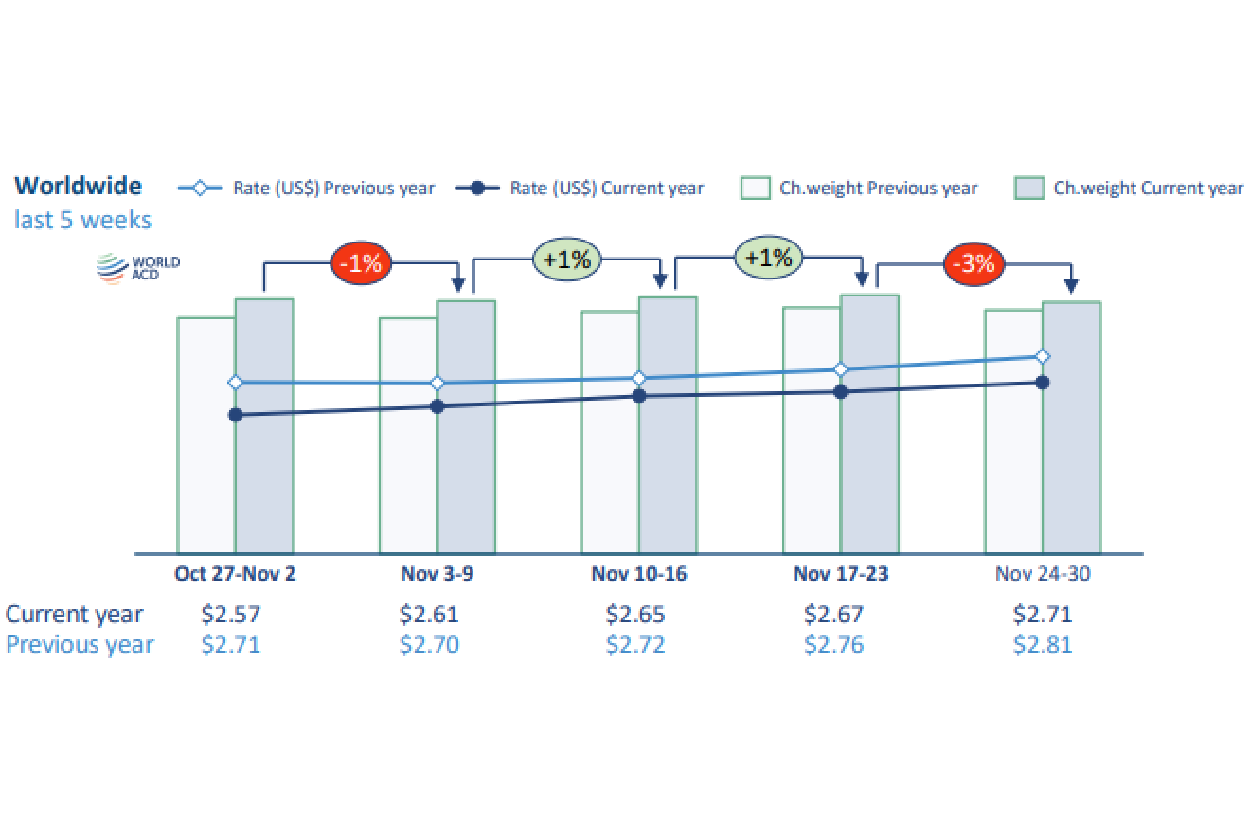
Worldwide air cargo tonnages in November continued their year-on-year (YoY) growth pattern with a +5% increase, slightly widening the YoY growth from the +4% recorded in October...

Industry faces talent retention challenge as workers cite outdated technology, career stagnation and insufficient training investment.

 ALS
ALS