


Singapore Changi Airport (SIN) is in the process of a major infrastructure project to increase its air cargo handling capacity, while growing its carrier portfolio and investing in digitalisation.
The airport is on a mission to grow its cargo capacity to 5.4m tonnes as air cargo demand soars out of Southeast Asia.
To enable this goal, the airport is remodelling its existing cargo facilities and building new ones, says Jaisey Yip, vice president, cargo business division at Changi Airport Group (CAG).
The current Changi West development is composed of four passenger terminals and the Changi Airfreight Centre.
A free trade zone, the approximately 70-ha Changi Airfreight Centre houses ground handling terminals operated by SATS and dnata, as well as facilities run by FedEx, UPS, SF Express and DHL.
The centre also encompasses five Changi Airport-owned and operated multi-tenant warehouse buildings, which house about 170 freight forwarders altogether, as well as transportation companies.
Now the airport is developing the Changi East Industrial Zone (CEIZ) for airfreight, air express and Maintenance, Repair and Operations (MRO) activities.
The CEIZ will be operational from the mid-2030s and support the growth of cargo volumes currently handled at the Changi Airfreight Centre, says Yip.
Then, following the opening of CEIZ, the Changi Airfreight Centre will be remodelled too.
In addition to this, the Singapore government has also announced plans to develop Airport Logistics Park of Singapore 2 (ALPS2), to be operated by government agency JTC
The current ALPS1 includes facilities run by major logistics companies such as DHL Global Forwarding, UPS Healthcare and the former Schenker, now owned by DSV.
ALPS2 will be built from approximately 2030 to further support logistics operations.
When work on both the CEIZ and Changi Airfreight Centre is completed, Yip says both will be “connected to form a single, integrated airport system” and Changi expects its air cargo handling capabilities will “increase to 5.4m tonnes per annum from the current 3m tonnes per annum”.
Notably, CEIZ is also part of the wider 1,080-hectare Changi East development, incorporating Terminal 5 – the airport’s fifth terminal; a three-runway system; landside and aviation support facilities; and the construction of tunnels and other underground systems.
Unlike at many airports globally, the lack of land doesn’t pose a problem for expansion. The airport has been reclaiming land from the sea for many years now. Terminal five and CEIZ is being built on reclaimed land.
Economic powerhouse
Growth at Changi has the backing of over a decade of trade growth in Southeast Asia.
The strengthening of air cargo supply chains in Singapore and the greater Southeast Asia region amid a volatile global economic landscape reflects the longer-term growth of economies in Southeast Asia.
This has been fuelled by the continued shift of production and supply chains to Southeast Asia with the China+1 strategy utilised by shippers.
This longer-term shift is coupled with changes brought about by last year’s US-China trade war and the end of the de minimis exemption for low-value goods into the US, which saw airlines move capacity away from China to Southeast Asia and also away from the transpacific trade lane to Asia-Europe.
“We remain confident of the growth potential of Southeast Asia, underpinned by a favourable operating environment and manufacturing capabilities in the region,” reflects Yip.
Citing an International Monetary Fund (IMF) report from last year, she highlights that: “Southeast Asia is poised to grow much faster than the global average from now until 2030. Changi Airport wants to play a part in this and be integrated into the regional supply chain as well.”
In terms of government trade initiatives, Yip points out that Singapore is part of the Association of Southeast Asian Nations (ASEAN) that aims to promote economic growth in the region, and off the back of this is signed up to the Regional Comprehensive Economic Partnership (RCEP), while also engaged in free trade agreements (FTAs), such as the Comprehensive and Progressive Agreement for Trans-Pacific Partnership (CPTPP), the members of which ASEAN also works with.
She adds that the Johor-Singapore Special Economic Zone (JS-SEZ) agreement, signed in January 2025 to enhance economic collaboration between Singapore and Malaysia, will help attract more manufacturing activities to Southeast Asia.
Demand is strong
Alongside the reassurance of trade growth, Changi is confident that it will have the demand to warrant its huge expansion.
The airport’s infrastructure investments are being met with increased activity.
Last year, air cargo demand at Changi increased by 4.5% year on year to 2.1m tonnes, and airlines are continuing to invest in services to the airport.
Most recently, Chinese express giant SF has selected Changi to be its first overseas hub as it looks to capitalise on growth in Southeast Asia and South Asia.
Last month, Qantas Freight also began a twice-weekly Sydney–Shanghai–Singapore service.
Back in September last year, JD Airlines began a Shenzhen Bao’an International (SZX)–SIN freighter route, operating three times a week.
The following month, Turkish Cargo also resumed flights at the airport. The airline is currently flying once a week from Istanbul (IST) to Singapore (SIN) via Tan Son Nhat International (SGN) in Ho Chi Minh City, and then back to IST.
The carrier is also operating a direct IST-SIN flight once a week.
Vietnam Airlines may also join the slew of freighter operators at Changi in the future. The airline spent last year converting Airbus A321 passenger aircraft into freighters and there are plans to operate these to destinations including Changi, which already serves some of the airline’s passenger flights.
Notably, Singapore’s flagship carrier, Singapore Airlines (SIA) and DHL Express partnered in 2022 to deploy five DHL-owned 777Fs with dual DHL-SIA livery for operation by SIA pilots on routes to the US via points in North Asia.
The partnership has seen the aircraft serving DHL Express’ South Asia Hub at Changi.
Express operations are a valuable part of the cargo growth story at Changi. All four express integrators, DHL, FedEx, SF Express and UPS, have facilities at Changi Airport. FedEx Express chose Changi as its South Pacific Regional Hub.
“Singapore has traditionally been a premier hub to the express integrators, particularly DHL, UPS and FedEx,” says Yip.
“In the last 12 months, they have continued to deepen their investment in Singapore.”
She added: “I would say that one notable trend for the express integrators is they are looking at how to further consolidate cargo from Southeast Asia, using Singapore as a gateway for exports into US.”
For example, in June last year, FedEx launched a direct non-stop flight from Changi to Ted Stevens Anchorage International (ANC).
“They have also expanded some regional frequency to consolidate cargo through Changi Airport for their outbound flight to US,” says Yip of FedEx.
“Likewise, for UPS as well, they have also added more regional connectivity, so that, again, there is more cargo consolidation at Changi Airport.”
Ground growth
As well as growing its relationships with airlines, ground handling development is also a priority for Changi.
“When it comes to reliability, it’s not just about efficiency in the air, but also efficiency on the ground. That’s why we are working very closely with our two ground handlers, SATS and dnata, to see how we can continue to improve ground efficiency.”
In May last year, SATS announced an investment of over S$250m for Singapore Hub (SG Hub), a division of SATS that aims to improve airfreight operations and incorporates the company’s activities at both Changi and Seletar Airport (XSP).
The investment will be used to improve SATS’ ground operations and to start upgrading its cargo handling infrastructure before CEIZ comes online.
The handler also opened a new air cargo facility at the airport in August.
Atlas Air, which has operated freighter flights into Changi in recent years, signed a cooperation agreement in February last year with SATS and its subsidiary WFS to expand cargo handling and support services in Singapore.
Additionally, dnata has invested in new ground support equipment, which it is taking delivery of this year, adds Yip.
As well as pure airfreight operations, intermodal operations at Changi have long been strong, especially compared to some other airports globally that saw significant ramp ups only when the Red Sea crisis started.
Yip points out that shippers are seeking diversified transportation options as part of their risk mitigation strategies.
“Rather than pure air or pure ocean options, they’re also looking at intermodal options to balance cost, speed and reliability.
The Port of Singapore has connections to over 600 other ocean ports, while Changi Airport is currently connected to 160 cities.
Although Yip says: “There are still more gaps out there that we want to plug.”
One initiative that has improved coordination between ocean and air operations has been the OptEModal intermodal shipment management platform, launched in August last year by port operator, PSA Singapore and Cargo Community Network (CCN).
The platform integrates real-time data streams across PSA terminals in Singapore, ground handlers and airline partners to track multimodal shipments and manage potential risks during mode transfers.
Its capabilities include multi-party visibility, AI-powered estimated time of arrival (ETA) predictions, proactive delay identification and smart flight recommendations, with the aim of reducing cost and complexity for shippers, forwarders and logistics providers, and enabling faster, smarter and more efficient sea-air intermodal transhipments.
Yip adds: “The tool is helping shippers with better visibility and helping Singapore become a more reliable transhipment hub.”
Source: https://www.aircargonews.net/interviews/2026/05/changi-goes-for-growth-with-infrastructure-rollout/
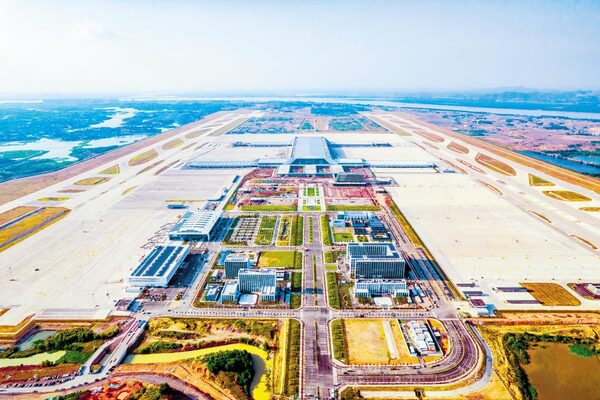
The launch of a dedicated air cargo route between Ezhou Huahu Airport in China’s Hubei province and Lahore marks the first time a direct freight air link has been established...

Although global sustainable aviation fuel (SAF) production is expected to increase by more than 26% in 2026 compared to the previous year, it will comprise just 0.8% of jet...

Freight forwarders are expected to see profitability remain under pressure despite a peace deal being reached by the US and Iran.
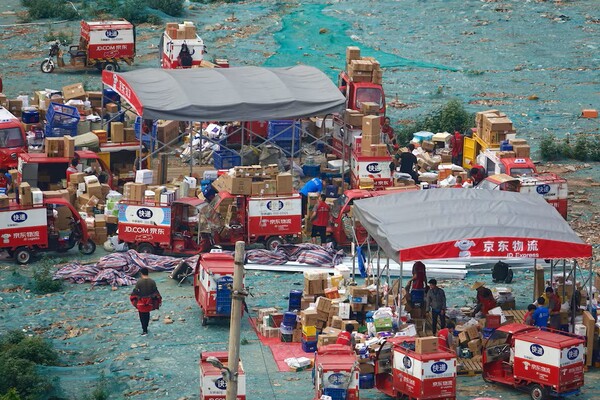
Promotions began in mid-May and run through June 20 to June 21. May retail sales fell 0.6% year-on-year. This year's event may provide clues on popularity of AI shopping tools
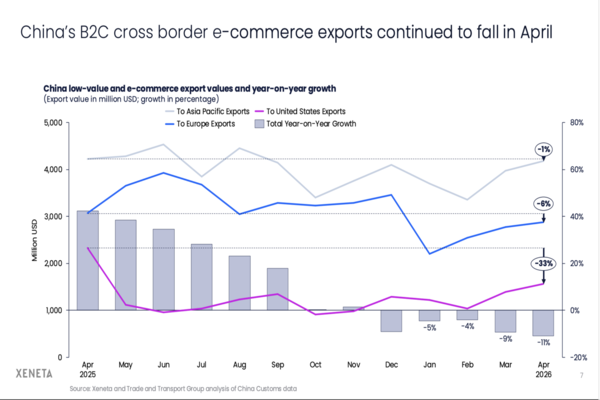
Chinese cross-border e-commerce exports continue to decline following regulatory changes in the US and increased scrutiny in Europe
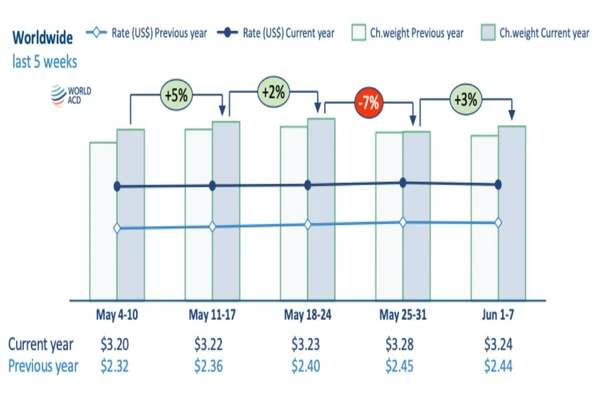
Air cargo activity stepped up a gear and airlines redeployed capacity after a slowdown in the previous week caused by a convergence of public holidays in Europe (Pentecost),...
TIGHTENING capacity, earlier peak season demand and rising rates are putting increasing pressure on air and ocean supply chains in the strong Asia Pacific region, according...
The airline association said that this year SAF production is expected to reach around 2.4m tonnes, up 25% from 2025 levels. However, the growth rate is down from the 90%...
Transport logistic Southeast Asia and air cargo Southeast Asia 2027 will focus on supply chain resilience as global trade faces growing disruption from geopolitical tensions,...
After a strong start to the year, cargo demand is now expected to grow by just 0.7% in 2026. Capacity shortages, especially in passenger bellyhold, are tightening the market...

 ALS
ALS